Winter Swimming Kit UK: What You Actually Need Below 10C
The short answer: Winter swimming kit in the UK comes down to three things in the water - 5mm neoprene gloves, 5mm zipped neoprene boots and a neoprene cap - plus a fast exit built around a waterproof changing robe, dry layers, a hat and a flask. Most UK winter swimmers do short dips in "skins" (a normal costume) rather than a wetsuit; a swim-specific wetsuit is for anyone staying in longer. No kit makes cold water safe: get out while you still feel good, dress before you feel cold, and never swim alone.
Once UK water drops below about 10C, the cold water swimming gear that got you through autumn stops being enough. Hands and feet go numb faster, the walk back to the car becomes the risky bit, and daylight runs out mid-afternoon. This guide is organised by moment - in the water, at the exit, in the dark - and ends with a first-winter shopping list in order of purchase. It pairs with our guide to winter swimming in the UK, which covers acclimatisation and how long to stay in.
| Question | At a glance |
|---|---|
| What do you actually need for winter swimming in the UK? | For short dips below about 10C: 5mm neoprene gloves, 5mm zipped neoprene boots, a neoprene cap, a waterproof changing robe, dry layers, a hat and a flask. The exit kit matters more than the swim kit. |
| Do you need a wetsuit? | Not for short skins dips, which is what most UK winter swimmers do. A swim-specific wetsuit if you want to stay in longer. Neither option is a lifejacket. |
| Biggest upgrade from autumn kit? | 3mm gloves to 5mm, thin neoprene socks to zipped 5mm boots, and a neoprene cap under your hi-vis silicone one. |
| How do you stay seen? | A hi-vis cap and a tow float on every swim, a head torch for dawn and dusk, and people who know where you are. A tow float is not a lifejacket. |
| What should you skip? | A microfibre poncho as your only robe, anything cotton, and any kit you have never worn before on the day. |
| Where should you swim? | Pick a spot on our free UK map and check its water-quality layer. Outside the official bathing season (15 May to 30 September in England) the rating shown is the last official classification, not a live reading. |
What do you need for winter swimming in the UK?
You need less than the adverts suggest: warm hands, feet and head in the water, and a rehearsed, warm exit on the bank. Everything else is a refinement.
Our year-round wild swimming kit list covers the season-proof basics; this page is the winter layer on top.
Kit slows the cold down; it does not stop it
Cold water shock, afterdrop and hypothermia happen to well-equipped swimmers too, and warmer kit is not a licence to stay in longer. The RNLI's Float to Live advice and the Outdoor Swimming Society both apply whatever you are wearing. Never swim alone, decide your time before you get in, and get out while you still feel good - if shivering stops, that is a warning, not progress.
Are 5mm gloves worth it for winter swimming?
Yes - for most people, moving from 3mm to 5mm gloves is the single most noticeable upgrade once the water sits below about 10C.
Neoprene does not keep water out. The foam itself insulates, and a snug fit stops cold water flushing through; the thicker the neoprene, the slower that layer loses its heat: warmer, but stiffer and clumsier.
Hands lose function before anything else in cold water. Clumsy fingers and "claw hand" are the classic signs that it is time to get out. Warmer hands do not extend your safe time, but they do make the minutes you have more comfortable and the exit less of a fumble.
The 3mm neoprene gloves most people start with are a good three-season pair - spring, summer, autumn. The 5mm Osprey gloves are noticeably warmer at the cost of some feel, and the adjustable wrist helps limit the cold water flushing in and out. Practise getting your robe on with them still on.
Boots or socks for winter swimming?
Boots. Thin neoprene socks are a summer and autumn item for shingle and rocks; in winter you want zipped 5mm boots with a proper sole.
Your feet are first in and last out, and numb feet on slippery ground is how winter swimmers fall over. The Osprey 5mm zipped boots have a reinforced toe and heel, and the zip is the underrated detail: peeling a tight sock off with fingers that no longer work is miserable, while a zip you can manage.
The 2mm neoprene socks still earn their place in the months either side of winter, when the problem is sharp stones rather than heat loss.
Neoprene cap, silicone cap or hood?
A neoprene cap for warmth with a hi-vis silicone cap over the top for visibility; a hood only if you swim long enough to want your ears and neck covered as well.
A 3mm neoprene swim cap makes an obvious difference to how the first minute feels; many swimmers wear one under or instead of a silicone cap. A hi-vis silicone cap is about being seen, not being warm - on its own it adds very little in winter. A neoprene hood gives fuller coverage and is mostly for longer swims; it also muffles your hearing.
| Choice | Warmer option | The trade-off | Best for |
|---|---|---|---|
| 3mm gloves vs 5mm gloves | 5mm, noticeably | Less feel, a little more effort to get on and off | 3mm from spring to autumn; 5mm once the water is below about 10C |
| 2mm socks vs 5mm zipped boots | Boots, by a long way | Bulkier and more drag if you swim hard | Socks for shingle in the warmer months; boots all winter |
| Neoprene cap vs silicone cap vs hood | Hood, then neoprene cap; silicone adds little | A hood muffles hearing and is more faff; silicone offers no real warmth | Neoprene cap for dips, hi-vis silicone over it for visibility, hood for longer swims |
Do you need a wetsuit for winter swimming?
No - most UK winter swimmers do short dips in skins, and a wetsuit only becomes worth it if you plan to stay in longer than a few minutes.
A short dip is quick in, quick out and fast to dress, whereas peeling a wet wetsuit off on a windy bank with numb hands is slow - and that wet, half-dressed spell is exactly when afterdrop bites. For a three-minute dip, a wetsuit can make the exit worse, not better.
A wetsuit earns its place when the swim is a swim rather than a dip: distance swimmers, anyone training through winter, or people who simply get cold very quickly. If that is you, buy a swim-specific suit, which is cut for shoulder movement in a way general-purpose suits are not.
The Zone3 Agile in the men's cut and the Zone3 Agile in the women's cut are the sensible starting points, with the Zone3 Glide as the step-up model. Our open-water wetsuit guide goes deeper on fit and sizing.
There is a middle path. A 3mm sleeveless neoprene thermal vest under a costume takes the edge off the core without the faff of a full suit.
A wetsuit is not a lifejacket
A wetsuit adds buoyancy and slows cooling. It does nothing about cold water shock in the first minute, because your face, hands and head still hit the water, and it will not swim you out of a rip current. If you get into trouble, the answer is still Float to Live: lean back, ears in, breathe, then act. A wetsuit also does not turn a cold swim into a safe one - you still get cold, just more slowly. The RNLI's general open-water advice is to wear a wetsuit; short skins dips are a winter-swimming convention rather than RNLI guidance, so treat them as the more exposed option.
What should you wear after a winter swim?
Everything, in the right order - the exit is where winter swimming goes wrong, because afterdrop means you will feel coldest 10-30 minutes after you get out.
When you climb out and start moving, your temperature can carry on falling, partly because chilled outer tissue keeps drawing heat from your core and partly as blood returns to cold limbs. The Outdoor Swimming Society warns that you are likely to feel colder ten minutes after you get out than you did in the water. The kit below exists to get you dry, covered and windproofed before it bites; our cold water safety guide explains the physiology.
Which changing robe do you need for winter?
A waterproof, windproof one you can get on with numb hands and change inside. The Dryrobe Advance long-sleeve is the original and the benchmark. The Two Bare Feet, Osprey and Regatta waterproof robes do the same job for a fraction of the price. What you cannot compromise on is the waterproof outer: a fleece or towelling robe that soaks through is not a winter robe. Our changing robes guide compares them properly.
What else goes in the exit bag?
- A waterproof changing mat. Bare feet on frozen mud or wet concrete undo everything your boots just did.
- A large quick-dry microfibre towel. Dry skin warms; wet skin keeps cooling.
- Loose, warm layers. Nothing tight, nothing with fiddly buttons, no skinny jeans. Big socks, a woolly hat, easy shoes.
- A 1.2L insulated flask for a hot, non-alcoholic drink after the swim, not before.
- Disposable hand warmers, opened before you swim. For the rewarming stage - in pockets or inside gloves once you are dry, never against numb bare skin you cannot feel.
The winter exit routine, in order
- Get out while you still feel good and go straight to your kit, which you laid out in order before you got in.
- Stand on the mat and get the robe on immediately. You dry and change inside it, out of the wind.
- Dry the top half first: head, torso, arms.
- Dress top-down. Hat first, then a base layer and a warm layer under the robe.
- Then the bottom half: dry, loose trousers, thick socks, shoes you can step into.
- Robe stays on and done up. It is your windproof layer for the next half hour.
- Flask: something hot, sweet and non-alcoholic, plus a snack.
- Hand warmers only now, into pockets or gloves once your hands are dry.
- Walk gently and keep moving. Leave the hot shower or bath until you have stopped shivering - rapid surface rewarming can make afterdrop worse - and no driving until you have properly stopped shivering.
How do you stay visible swimming in the dark?
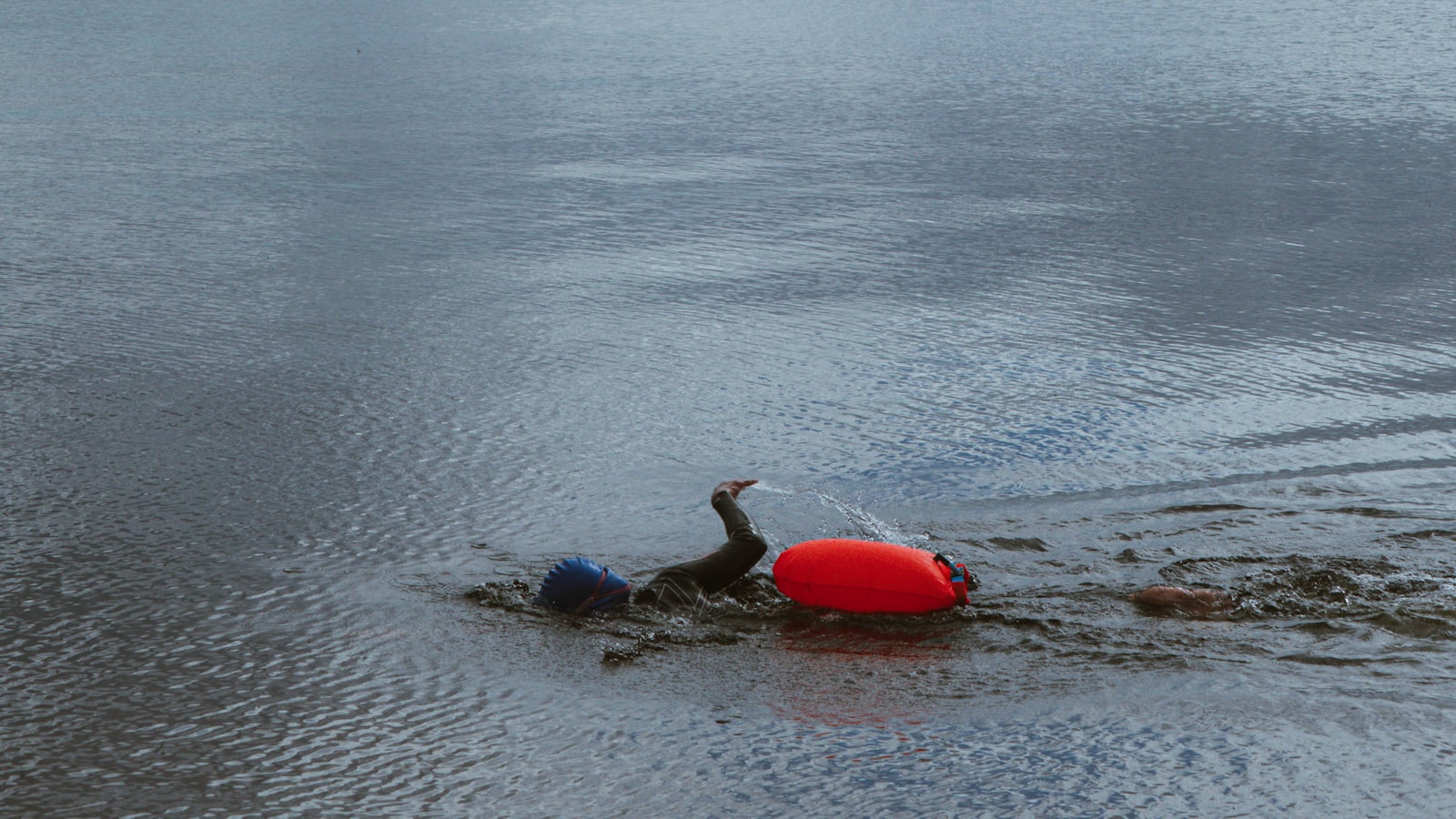
A bright cap, a tow float, a head torch on the bank and - above all - other people who know exactly where you are and when you are due out.
Around the shortest days most of the UK gets roughly eight hours of daylight, less further north, so a December swim before or after work is a dawn or dusk swim. No piece of kit changes the basics: never alone, tell someone your plan, know your exit, and stay parallel to the shore where you can stand up.
- Hi-vis silicone cap over your neoprene cap. Bright orange or pink shows up against grey winter water in a way navy never will.
- A tow float on every swim. The Cressi swim buoy gives you a bright marker and something to hold and rest on; the Zone3 28L buoy with dry-bag storage carries your keys and phone too; both buoys have a dry-bag compartment. A tow float is not a lifejacket and will not keep an unconscious person's face out of the water. See our tow float guide.
- A rechargeable head torch for dawn and dusk: they come as a two-pack, so wear one and leave one shining on your kit so you can find your exit. Check the beam actually lands on you and your kit; it is not a substitute for lifeguards or a swim buddy.
What should you buy first for your first winter?
If you are starting from a summer costume and a towel, buy in this order and stop whenever the budget runs out. Each item earns its place before the next one.
- 5mm neoprene gloves - the biggest single difference to the swim and to how well your hands work on the bank.
- 5mm zipped neoprene boots - warm feet and a sole for the walk in and out.
- Neoprene swim cap - takes the sting out of the first strokes.
- A waterproof changing robe - the Two Bare Feet, Osprey or Regatta if money is tight, the Dryrobe Advance if it is not.
- Insulated flask - a hot drink for after, every swim.
- Changing mat - a small spend that makes the exit faster and drier.
- Hand warmers - a multi-pair pack at the start of the season; keep two in your coat.
- Hi-vis silicone cap and tow float - move these up if you swim anywhere with boats, paddleboards or a dark shoreline.
- Head torch - for dusk swims, which in a UK winter is most weekday swims.
- A swim-specific wetsuit - only once you know you want to stay in longer. Men's and women's cuts.
What winter swimming kit is nice to have?
Once the essentials are sorted, a floating thermometer, ear plugs and a dry bag all earn their place; nothing on this list is urgent.
- A floating water thermometer. Know the number. UK sea temperatures typically bottom out around 6-9C in February and March and inland water runs colder.
- Swimming ear plugs. Cold water in the ear canal can leave you dizzy on exit, and many regular cold-water swimmers wear them year-round against the ear-canal narrowing often called surfer's ear.
- Neoprene buoyancy shorts. Warmth around the hips and some lift in the water; distance swimmers tend to appreciate them more than dippers do.
- A roll-top dry bag. Wet kit home without soaking your dry layers on the way.
- A waterproof phone pouch. Keeps your phone usable on the bank for the call you hope never to make.
What winter swimming kit should you skip?
Anything that stands in for a real robe, anything cotton, and anything you have never worn.
- A poncho as your only robe. A microfibre changing poncho is a lightweight summer item. It is not waterproof and does next to nothing about wind, so in January it soaks through and you keep cooling. Keep it for July and buy a waterproof robe for winter, even the cheapest of the three above.
- Cotton anything. Cotton holds water against your skin and pulls heat out of you while it dries, exactly what you do not want during afterdrop. That includes the hoodie you would normally reach for, cotton joggers, socks and beanies. Fleece, wool and synthetics only.
- New kit on the day. Practise boot zips at home with cold hands, wear new gloves on an autumn swim first, and put a new wetsuit on in the warm to learn where it pinches. Neoprene has to fit snugly to work; a baggy glove or boot fills with cold water and does nothing.
Does water quality matter in winter?
More, not less - sewage storm overflows spill more often in wet winter weather, so the water-quality layer on our map matters more in December than in July.
The Environment Agency's official bathing season in England runs from 15 May to 30 September, so outside those dates the rating you see on the Wild Swim Map is the last official classification for that spot, not a live reading of today's water. Many swimmers also leave rivers alone for a day or two after heavy rain, when they run high and fast and overflows spill most. Our guide to UK water quality for swimmers explains how the ratings work.
Who should talk to a GP first
Cold water places real strain on the heart and circulation. If you have a heart condition, high blood pressure, asthma or Raynaud's, are pregnant, or take medication affected by cold, talk to your GP before winter swimming. Many swimmers report feeling better for it, but this page is general information, not medical advice.
New to winter water?
The safest way in is to keep swimming through autumn as the temperature falls rather than starting cold in January, as the Outdoor Swimming Society recommends. Read our guide to winter swimming in the UK for acclimatisation and how long to stay in, then find a sheltered spot near you on our free UK map.
Frequently asked questions
What do you need for winter swimming in the UK?
For short winter dips you need warm extremities in the water - 5mm neoprene gloves, 5mm zipped neoprene boots and a neoprene cap - and a fast, warm exit built around a waterproof changing robe, dry loose layers, a hat and a flask. A hi-vis cap and a tow float help you be seen. Most UK winter swimmers dip in a normal costume rather than a wetsuit, and no kit makes cold water safe, so keep swims short and never go alone.
Do you need a wetsuit for winter swimming?
No. Most UK winter swimmers do short dips in skins because a wet wetsuit is slow to get off on a cold bank, which is exactly when afterdrop bites. A swim-specific wetsuit makes sense if you want to stay in longer than a few minutes or train through winter. A wetsuit is not a lifejacket: it slows cooling and adds buoyancy but does nothing about cold water shock.
What thickness gloves do you need for winter swimming?
5mm neoprene gloves are the usual winter choice: they are noticeably warmer than the 3mm pair many swimmers start with, at the cost of some feel. 3mm gloves are a three-season pair for spring and autumn. Hands lose function first in cold water, so warmer gloves make the swim more comfortable and the exit easier, but they do not extend how long it is sensible to stay in; clumsy fingers are still your cue to get out.
Are neoprene socks or boots better for winter swimming?
Boots. Thin 2mm neoprene socks protect your feet from shingle and rocks in summer but offer little warmth. 5mm zipped neoprene boots with a reinforced toe and heel keep your feet warmer in the water, give you a sole to walk on over frozen ground, and have a zip that is easier to work with numb fingers.
Should I wear a neoprene cap or a silicone cap for winter swimming?
Both, layered. A neoprene cap provides the warmth and a hi-vis silicone cap worn over it provides the visibility, because silicone on its own adds very little warmth in winter. A neoprene hood gives fuller coverage of the ears and neck but is mostly for longer swims and muffles your hearing.
Is a Dryrobe worth it for winter swimming?
The Dryrobe Advance is the original waterproof changing robe and the benchmark, but it is not essential. Cheaper waterproof changing robes from Two Bare Feet, Osprey and Regatta do the same job for a fraction of the price. What matters is that the robe is waterproof, lined and long enough to change under; a microfibre poncho is not a winter robe.
How do you warm up after a winter swim?
Get out while you still feel good, dry off quickly and dress from the top down: hat first, then dry top layers, then legs, standing on a mat rather than the ground. Have a hot non-alcoholic drink, put hand warmers in your pockets once you are dry, and walk gently for a few minutes. Leave the hot shower or bath until you have stopped shivering and do not drive until you have stopped shivering, because afterdrop can keep cooling you for ten to thirty minutes after you leave the water.